Against "Slop"
A Particularly Online Rant

We have fallen victim to a right-wing tactic! But first, some words about words.
It is the natural beauty of a language to evolve over time, to reconfigure the meaning of words, to produce new ones, to revive old ones. This sinuosity of language can sometimes lead to frustration (I discovered the dual definitions of the word nonplussed, and was pretty nonplussed about it (the correct nonplussed)), but overall it is an indicator of communication, community and engagement in and between populations, made worldwide through social media, and I think that’s just swell.
Social media, however, brings its own concerns. I will be expecting my award for most obvious statement ever recorded in the mail.
As an ecosystem, social media thrives on the most easily digested content (accepting my second award in the mail also). Thoughts made succinct. Pithy one-liners. Big, blocky subtitles in Super Mario font on a vertical video with a Minecraft parkour run in the corner. This is particularly evident with Twitter—it as a concept encourages pithiness. Not only that, but the Twitter algorithm is also hard-coded to serve opinions tailor-made to cause friction, especially relating to topics you are invested in. Every week there is a new discourse rolled in by annoying contrarians and engagement farmers about how a reasonably decent piece of media is bad, actually.
Negativity drives engagement. I’ve noticed that my less than stellar reviews on my bookstagram receive more attention, especially if they’re about a hot book (I was not particularly warm about Martyr! or Annihilation, for example, and my reviews garnered greater than average engagement). Basically, I get it. But it’s an annoyance when, rather than a few paragraphs detailing why you did not like something—for I’m always happy to engage in conversations about media I like with others of differing opinions—the sum of the critique is This is shit and you’re stupid if you like it… Essentially, the Twitter modus operandi. But even this is preferable to the newest trend of derisiveness that has overtaken Twitter and spread into other platforms. The accursed “slop”.
Slop in the current sense had noble beginnings. An incisive cut against the hordes of tech bros and baby boomers running rampant with AI, insisting that their dollhouse imaginings of non-Euclidean spaces and favourite Marvel characters would outmode every one of the arts, and when prompted to showcase an example of some real, groundbreaking stuff, could not produce much more than videos of dogs saving babies from a car pile-up, or videogames with assets stolen from Elden Ring. This stuff is slop. The word itself is so evocative, so encompassing of the dross these people generate. When I hear about Microsoft begging people to stop referring to them as Microslop after their AI rollout, I feel a little happy inside. But the sinuosity of language I spoke of before has applied to this modernity, and has dovetailed with social-media-shortform in the worst way possible. Slop has become a suffix.
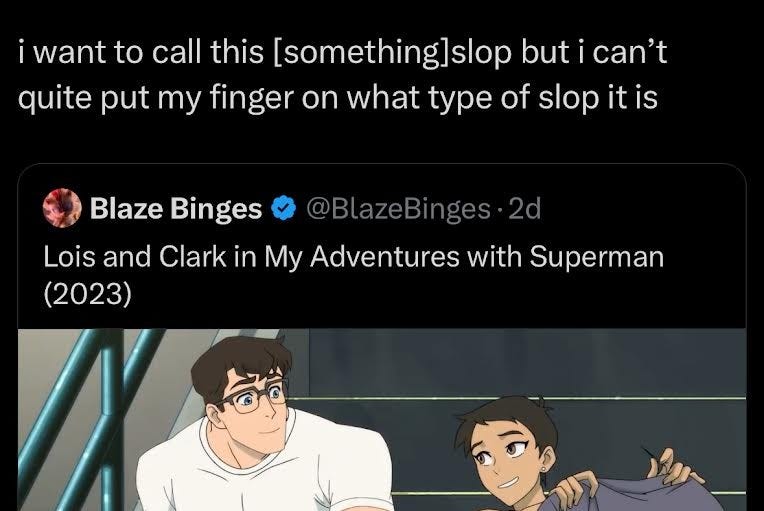
There are so many offshoots on the taproot of the internet, who is to say which community, space or figure made the very first [descriptor]slop reference. I hope they feel like Oppenheimer. To name a few of the examples I have seen:
Games with clear inspiration drawn from Fromsoftware are called Rollslop
Games designed around co-op are called Friendslop
On one occasion, movies with Meryl Streep were called Streepslop (seriously)
Hipsterslop to describe games without a gun or ball in it
Project Hail Mary was described so: Heartwarming: millennial reddit chungus directors still serve American exceptionalist slop the old-fashioned way
A24 slop
Romantasyslop
Slopslop — enough!
And it is such a convenient method! All of the derogatory without any of the explanatory. One can announce themselves and their dislike of a thing and then make a quick getaway, unperturbed by concepts such as reasoning or good faith. And this easiness, like all sorts of other easinesses, is contributing to the literacy crisis as we dig ourselves deeper and deeper into a nadir of incomprehension.
It delegitimises the art, crafted by real people spending time and money, by weighing criticism down with a word once reserved for AI. A bad piece of art is a lesson, an unenjoyed piece of art is an instructor of taste; AI generated in a few seconds with no sweatwork is neither of these, unless the lesson is that all art generated is uniformly unoriginal, and the instructor of taste is that you have zilch. In a word: Slop. Keep the real bad art away from this label. Yes, even Stranger Things season 5.
I’ll address the hook at the start of this little piece now. Yes, I believe that the usage of Slop that I take such umbrage with falls into the domain of word tactics that notable right-wingers such as Donald Trump and Nigel Farage have employed. Obviously Slop is not as serious as their political leverings, but they are alike, in the same way a chihuahua is in the same genus as a mastiff. The tactic is called Thought-Terminating Cliché.
If you’re unfamiliar with the term, Joan Didion described it as:
…a way of talking that tends to preclude further discussion, which may well be its intention.
The Cliché is wielded in such a way as to cinch shut any potential critical thinking or thought about a thing, which is obviously very valuable for our devil politicians. It’s why Trump leans so heavily on buzzwords, Drain the Swamp and Big Beautiful Bill and so forth, to jangle keys and distract his followers from thinking about his true intentions. It’s why Farage has made Stop the Boats his number one message. It is why terms such as “antifa”, originally a shortened version of anti-fascist, has become a blanket descriptor for anyone the right does not like, alongside “radical left”. It’s why “Thoughts and prayers” has become an infamous and often-mocked stock phrase in response to tragedy, rather than discussing what caused the tragedy in the first place, and more importantly, what could be done to prevent it. It’s why “Do your own research” is deployed by conspiracy theorists, almost as a shield, or sand whipped from a pocket and thrown against reality.
Ultimately for this piece, it is a small part of why critical discussion of art, books, movies, music, games, you name it, continues to founder. Because the most popular tweets refer to them as various forms of Slop, and rake in the easy likes. Why did Andrea Long Chu write the Pulitzer Prize-winning article lambasting A Little Life when she could have just called it Tragedyslop? It probably would have resonated more and earned some Twitter money. But at what cost?
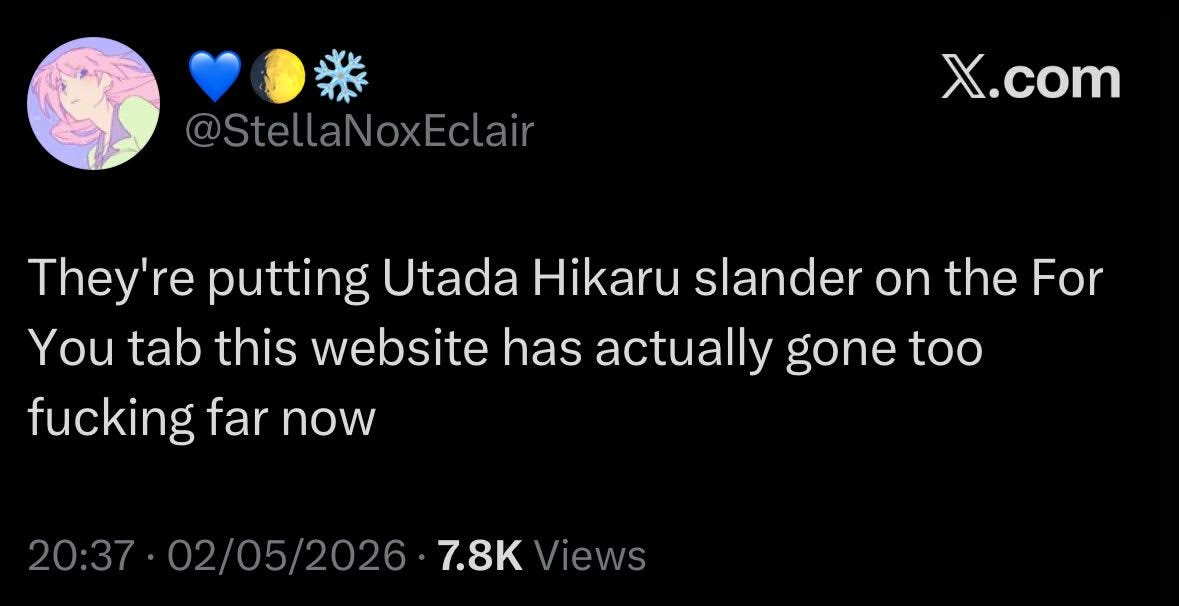
Maybe I should just close Twitter. It has definitely decreased in quality DRASTICALLY since the world’s least funny billionaire bought it. It is probably doing irreparable damage to my brain when I log into the ragebait machine every day. But where else would I get my daily dose of people roleplaying as fantasy characters on social media? Definitely not Threads.